
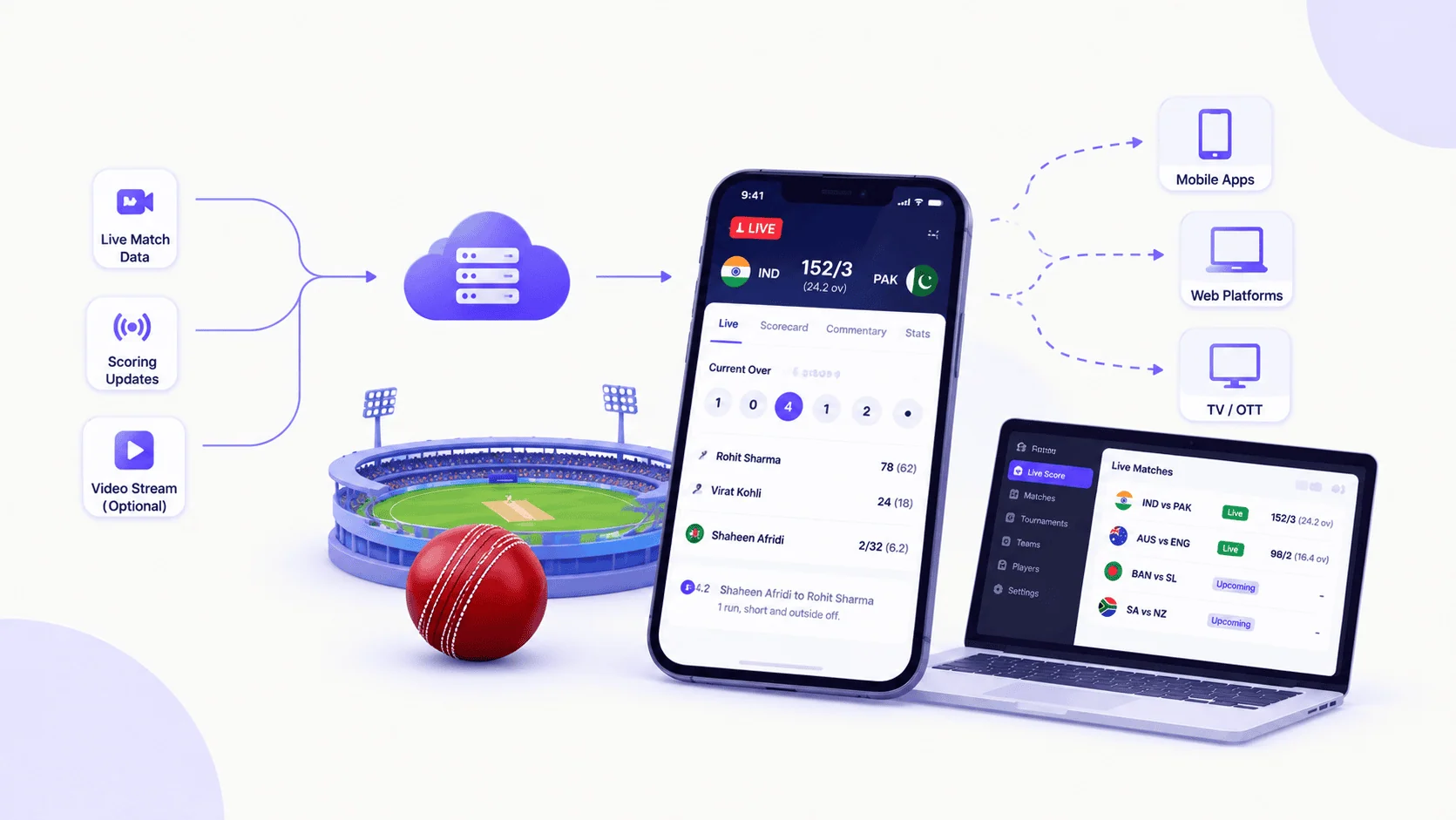
What if every boundary, goal, wicket, and winning point could travel from the field to millions of screens in the blink of an eye? No waiting for scorecards. No endless refreshing. Just the thrill of the game, delivered one moment at a time.
That is the power of live score software.
Behind every score that changes in real time lies an intricate system of data capture, intelligent processing, scoring logic, and instant communication. A single event on the field can trigger a chain reaction, updating player statistics, reshaping tournament standings, and notifying fans thousands of miles away. What looks effortless on a screen is actually the result of multiple technologies working together with remarkable precision.
But how does software understand the rules of different sports, calculate scores correctly, and deliver updates so quickly? What happens between the moment a player makes a move and the moment the world sees the result?
In this blog post, we go beyond the scoreboard to uncover how live score software like CricoScore actually works, the technology that powers it, and the systems that make real-time sports experiences possible. Whether you are a sports enthusiast, tournament organizer, developer, or entrepreneur exploring sports technology, you will discover what happens behind the scenes every time the score changes.
What Is Live Score Software?
Live score software is a digital system that records, processes, and displays sports scores and match information as events happen. It helps users follow matches in real time without manually refreshing pages or waiting for traditional score reports.
Depending on the sport and platform, live score software can display current scores, match time, player statistics, wickets, goals, penalties, cards, substitutions, overs, sets, innings, and other relevant information.
For example, a cricket live score system may show runs, wickets, overs, batter statistics, bowler figures, and the required run rate. A football live score platform may display goals, match time, cards, substitutions, and possession statistics when available.
Live score software is commonly used by sports apps, club management platforms, tournament organizers, sports news websites, broadcasters, and online sports communities.
Its primary purpose is simple: make accurate match information available to the right people as quickly as possible.
How Does Live Score Software Work?
Live score software works through a sequence of connected processes: capturing match events, validating the data, updating the match state, storing the information, and distributing updates to users.
Although the exact architecture differs between platforms, most systems follow a similar workflow.
Step 1: Match data is captured
The process begins when an event occurs during a match.
A cricket batter scores four runs. A football player scores a goal. A tennis player wins a point. Each event must be recorded before the software can update the score.
Data can enter the system in several ways.
Manual scoring: An authorized scorer enters match events through a mobile app, tablet, or web-based scoring interface.
Automated data collection: Cameras, sensors, tracking systems, or connected devices capture selected events. The technology required depends on the sport and level of automation.
External data feeds: A platform receives match information from an authorized sports data provider or an official competition system.
Many grassroots tournaments rely on manual scoring because it is practical and affordable. Professional competitions may combine trained operators, specialized equipment, and external data infrastructure.
Step 2: The software validates the event
Once an event is submitted, the software checks whether it is valid within the match context.
For example, a cricket scoring system may need to distinguish between a legal delivery, a wide, a no-ball, a wicket, and a boundary. These events affect the score and match statistics differently.
A football scoring system may need to record a goal, its timestamp, the player involved, and whether the goal has been confirmed by the authorized match official.
Validation rules help prevent incorrect entries, inconsistent statistics, and impossible match states.
Some systems also support corrections, reversals, and event editing. This is important because a scorer may accidentally select the wrong player or enter an incorrect result.
Step 3: The match score is updated
After validation, the software applies the event to the current match state.
Suppose a cricket team has scored 84 runs for two wickets. The batter hits a boundary worth four runs.
The system processes the event and updates the team score to 88 runs for two wickets, assuming no other scoring adjustments are involved. It also updates relevant player statistics, ball-by-ball information, and other dependent calculations.
In football, a confirmed goal changes the scoreline and may update the scorer’s statistics and match timeline.
The important point is that the software does more than replace one number with another. It must keep related match data consistent.
Step 4: Match information is stored
The updated score and event are saved in a database or another suitable storage system.
Depending on the platform, the stored information may include the current score, individual scoring events, player profiles, team details, match status, tournament information, and timestamps.
Maintaining an event history is particularly useful because it allows the system to reconstruct the match, calculate statistics, review scoring corrections, and support post-match reporting.
A well-designed system separates the latest match state from the underlying event history while keeping them consistent.
Step 5: Real-time updates are distributed
Once the match state changes, the software sends the update to connected applications and interfaces.
This is where real-time communication technology becomes important.
A basic platform might rely on frequent requests from the user’s browser. More responsive platforms may use WebSockets or Server-Sent Events to push updates to connected clients without requiring a full page refresh.
The update can then appear on a live score page, mobile app, tournament dashboard, scoreboard, or other authorized integration.
For example, a cricket fan following a match on a mobile app may see the score change immediately after the scorer records a boundary.
The exact delay depends on how quickly the event is entered or detected, processed, transmitted, and rendered on the user’s device.
Step 6: Users receive live scores and notifications
The final step is presenting the information in a useful format.
Fans may see the current score, match timeline, player statistics, team lineups, and tournament standings. Organizers may see scoring controls, match progress, and administrative tools.
Some platforms also support push notifications for important events, such as a goal, wicket, innings break, or final result.
Notifications are usually triggered by defined match events and delivered through a separate notification service. They are not the same as the live score update itself.
When these components work together, a single scoring event can update multiple connected experiences.
What Technologies Power Live Score Software?
Live score software usually combines several technologies rather than relying on a single tool. Each component serves a different purpose.
Frontend technology
The frontend is the part users interact with. It includes the scoring interface used by match officials and the screens fans see on websites or mobile apps.
Web interfaces may use technologies such as React or other JavaScript frameworks. Mobile applications may use native iOS and Android development tools or cross-platform frameworks.
A good frontend should display changing information clearly, respond quickly to user actions, and remain usable on different screen sizes.
Backend and scoring engine
The backend handles the application’s core logic. It validates scoring events, applies sport-specific rules, manages match states, controls permissions, and coordinates data distribution.
The scoring engine is especially important because each sport has its own rules. A generic counter is not enough to handle the full complexity of cricket, football, tennis, basketball, or other sports.
Database and event storage
A database stores match records, teams, players, tournaments, scores, and statistics.
Relational databases are useful when data has structured relationships, such as players belonging to teams and teams participating in tournaments. Other storage systems may support particular performance or event-processing requirements.
The right database design depends on expected traffic, data relationships, reporting needs, and consistency requirements.
Real-time communication
Real-time communication allows the system to send updates to connected users.
WebSockets support two-way communication between clients and servers. They are useful when applications need continuous updates and interactive communication.
Server-Sent Events (SSE) provide a way for servers to push updates to web clients over a persistent connection.
Polling periodically requests new information. It is easier to implement in some situations but can introduce unnecessary requests and additional delay.
A platform may combine these approaches depending on its architecture and client requirements.
APIs and integrations
An API allows other applications to access authorized data or functionality.
For example, a live score API may provide match details, current scores, player statistics, or tournament standings to a third-party sports website.
APIs help developers integrate live scoring into existing products without rebuilding the entire scoring infrastructure.
Cloud infrastructure and content delivery
Cloud infrastructure can help a live score platform handle changing traffic, maintain service availability, and scale its processing capacity.
Caching and content delivery networks can improve the delivery of suitable content, especially when many users request the same public match information.
However, frequently changing live data requires careful cache management. Stale scores can undermine the value of an otherwise fast application.
How Does Live Score Software Update Scores in Real Time?
Real-time score updates generally rely on event-driven processing and persistent communication between the server and connected clients.
When an event is recorded, the backend validates it, updates the match state, and publishes a message to the relevant subscribers. Connected applications receive the message and update their displays.
For example, a live score application may use WebSockets to send a score change directly to users following a match. If a user temporarily loses connectivity, the application can reconnect and retrieve the latest authoritative match state.
There is an important distinction between real-time delivery and real-time data capture. A platform may transmit information almost instantly after receiving it, but it cannot display an event that has not yet been entered or detected.
For this reason, overall update speed depends on the entire chain: event capture, validation, processing, network delivery, and interface rendering.
How Does Live Score Software Handle Different Sports?
The underlying architecture may be similar across sports, but the scoring logic and statistics must reflect each sport’s rules.
| Sport | Typical live data | Special scoring requirements |
|---|---|---|
| Cricket | Runs, wickets, overs, batter and bowler figures | Legal deliveries, extras, innings, strike changes and dismissal rules |
| Football | Goals, match time, cards, substitutions | Goal events, stoppage time, match periods and extra time |
| Basketball | Points, fouls, rebounds, player statistics | Periods, free throws, three-pointers and possession-related events |
| Tennis | Points, games, sets and match score | Sport-specific point progression, tiebreaks and set rules |
| Volleyball | Points, sets and team rotations where supported | Set progression, service changes and match format |
A multi-sport platform must support these differences without forcing every sport into the same scoring model.
For example, cricket requires ball-by-ball event handling, while tennis requires a scoring model that can represent points, games, sets, and tiebreaks. A flexible architecture allows the platform to share common capabilities while maintaining separate sport-specific rules.
What Is the Difference Between Live Score Software and a Live Score API?
Live score software is the broader system used to manage, process, and display live sports information. A live score API is an interface through which applications exchange or retrieve that information.
A live score platform may include scoring tools, databases, tournament management, user accounts, statistics, and a live display.
A live score API may expose selected data from that platform or from an external sports data provider.
Developers building a sports application can use an API to add live scores without creating a complete data collection and scoring system from scratch. However, the API’s capabilities depend on its provider, available sports, data coverage, access permissions, pricing, and update frequency.
If a platform needs to support local tournaments where no external feed exists, it may need its own scoring interface and backend in addition to any APIs it consumes or provides.
Essential Features of Live Score Software
The best feature set depends on the sport, audience, and competition level. Nevertheless, several capabilities are especially valuable.
Live score tracking
The software should display the latest valid score and match status, with updates delivered efficiently to connected users.
Player and team statistics
Detailed statistics help users understand more than the current result. Depending on the sport, these may include individual performance, team comparisons, scoring history, and match summaries.
Match and tournament management
Organizers may need tools to create fixtures, register teams, manage schedules, record results, and calculate standings.
Notifications and match alerts
Users can receive notifications for selected events, such as goals, wickets, match starts, or final results. Personalization helps fans follow the matches that matter to them.
Live commentary and match timelines
A chronological record of key events gives viewers context and makes it easier to understand how the match developed.
Multi-platform access
A live score service may support websites, mobile apps, tablets, electronic scoreboards, and third-party integrations.
Reporting and analytics
Post-match reports help clubs, coaches, organizers, and analysts review performance and competition results.
Security and access control
Scoring permissions should reflect user roles. For example, authorized scorers may record events, administrators may correct match records, and public viewers may only read published information.
Recovery and data consistency
Reliable systems should account for connection failures, duplicate submissions, accidental entries, and interrupted sessions. Event histories, validation rules, backups, and carefully designed recovery mechanisms help protect score accuracy.
How Accurate Is Live Score Software?
Live score software can provide highly accurate information when its data sources, scoring rules, and operational processes are reliable. However, accuracy is not guaranteed simply because the software updates quickly.
Manual scoring depends on the scorer entering the correct event. Automated systems depend on their detection capabilities and validation processes. External feeds depend on the quality, coverage, and timeliness of the provider.
A robust platform reduces mistakes through rule-based validation, authorized corrections, event logging, duplicate-event protection, and consistency checks.
For important competitions, organizers should also define who can confirm scoring decisions and how disputed or corrected events are handled.
The key is to design the system so that speed and accuracy support each other rather than compete.
How Much Does Live Score Software Cost?
The cost of live score software varies according to the sport, required features, number of competitions, audience size, data sources, and level of customization.
A basic scoring application for local tournaments may need only a scoring interface, match records, and a public score display. A large commercial platform may require multi-sport support, advanced statistics, third-party APIs, cloud scaling, analytics, push notifications, and extensive administration tools.
Other potential costs include external sports data subscriptions, hosting, mobile app development, maintenance, support, and integration work.
For a business evaluating live score software, the most useful approach is to compare the total cost of ownership against the capabilities required today and the expected needs of future competitions.
How to Choose or Build Live Score Software
The right solution should fit the actual scoring workflow, not just offer an attractive live score screen.
Start by identifying the sport or sports the platform must support. Document the rules, event types, statistics, and competition formats that matter.
Next, determine how match data will be captured. Will authorized scorers enter events manually, will the platform integrate with an external data provider, or will it use automated tracking technology?
Then define the user experience for scorers, organizers, players, and fans. Consider whether the product needs mobile applications, a web dashboard, public score pages, APIs, or tournament administration.
Evaluate update speed, reliability, correction workflows, access controls, and the ability to recover from network interruptions. Also consider expected concurrent users and whether the system can scale during major matches.
Finally, test the product in realistic match conditions before deploying it broadly. A system that works well during a small test may behave differently when multiple matches and thousands of viewers are active.
For businesses with specialized requirements, custom development can offer greater control over scoring rules, integrations, branding, and future functionality. Ready-made software may be more practical when standard features meet the need.
The Future of Live Score Software
Live score technology continues to evolve as sports organizations and fans demand richer, faster, and more interactive experiences.
Artificial intelligence may help analyze match footage, extract selected events, generate summaries, or identify patterns in sports data. Computer vision and sensor technology can support automated data collection in suitable environments.
Personalized alerts, advanced statistics, interactive visualizations, and deeper integrations can make live score platforms more useful for fans, coaches, and tournament organizers.
These capabilities also introduce challenges. Automated event detection must be validated, sensitive data must be protected, and statistical insights should be presented with appropriate context.
The strongest systems will combine useful innovation with reliable scoring foundations. Regardless of how sophisticated a platform becomes, users still need match information they can trust.
Conclusion
Live score software works by capturing sports events, validating scoring information, updating the match state, storing records, and distributing changes to connected users. Its effectiveness depends on the coordination of scoring logic, databases, real-time communication, APIs, and a reliable user interface.
For fans, the result is a convenient way to follow matches from anywhere. For clubs and tournament organizers, it means more efficient scoring, clearer reporting, and better access to match information. For sports technology businesses, it creates opportunities to build connected experiences around live competitions.
As sports continue to embrace digital tools, live score software will remain an important part of how matches are recorded, followed, analyzed, and shared.
Building the next generation of sports technology starts with understanding the systems that make real-time experiences possible.
Frequently Asked Questions About Live Score Software
What is live score software used for?
Live score software records and displays sports scores and match events as they happen. It is used by sports apps, websites, clubs, tournament organizers, broadcasters, and other platforms that need up-to-date match information.
How does live score software get match data?
It can receive match data from manual scorers, connected scoring devices, automated tracking systems, or external sports data feeds. The method depends on the sport, competition, and software capabilities.
How are live scores updated instantly?
After an event is captured and validated, the backend updates the match state and distributes the change to connected applications. Technologies such as WebSockets and Server-Sent Events can deliver updates without requiring users to refresh a page.
Does live score software require an internet connection?
Cloud-based live score systems generally need internet connectivity to distribute updates to remote users. Some scoring applications can support offline event entry and synchronize changes when connectivity returns, but this functionality depends on the implementation.
Can live score software support multiple sports?
Yes. Multi-sport systems can support different scoring rules through sport-specific scoring engines or modules. Each sport requires its own event definitions, calculations, and validation rules.
What is a live score API?
A live score API allows an application to retrieve or exchange authorized sports data, such as match scores, player statistics, and tournament information. Developers use APIs to integrate live sports information into websites and apps.
Is live score software accurate?
It can be highly accurate when events are captured correctly, scoring rules are implemented properly, and validation and correction mechanisms are in place. Accuracy also depends on the quality and timeliness of the data source.
Can I build my own live score software?
Yes. A custom platform can include scoring interfaces, sport-specific scori