
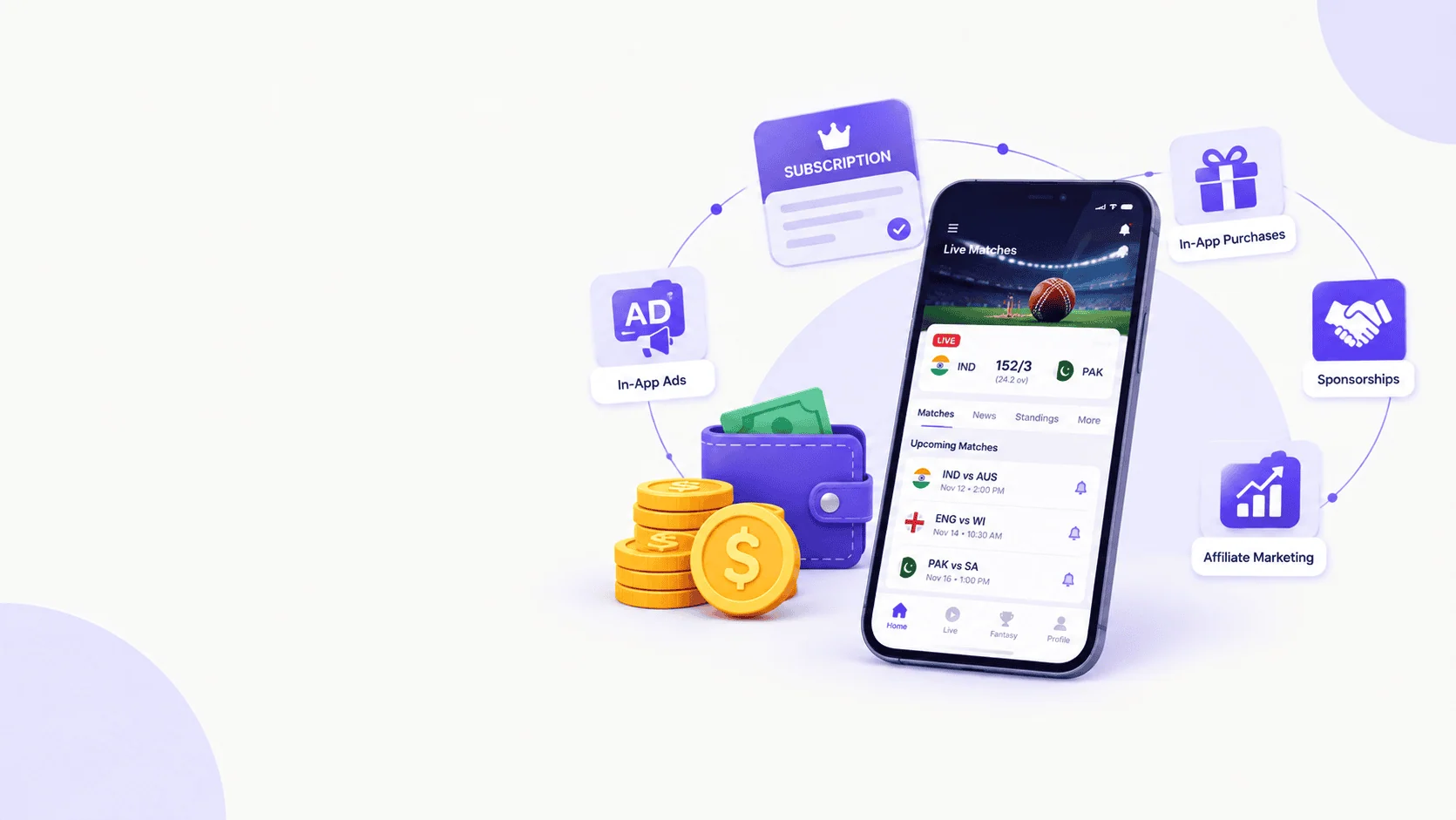
What if every match score checked, every tournament followed, and every minute of live sports watched could become an opportunity to generate revenue? The sports app market offers exciting opportunities for entrepreneurs, developers, and sports businesses, but building an app that attracts users is only half the game. Turning those users into sustainable revenue is where the real challenge begins.
Whether you’re planning a live cricket scoring app, a sports streaming platform, a tournament management system, or an all-in-one sports community, the right monetization strategy can turn your idea into a profitable business. From in-app advertising and premium subscriptions to sponsorship deals, live-stream revenue, and paid software features, there are multiple ways to make money without sacrificing the user experience.
But which strategy delivers the best results? How many users do you need to start earning? And can a small sports app compete with established platforms?
In this blog post, we’ll explore 10 practical ways to monetize a sports app, break down real-world revenue calculations, compare the best business models, and show you how to build a monetization strategy designed for long-term growth.
Quick Answer: How Do You Monetize a Sports App?
You can monetize a sports app through in-app advertisements, premium subscriptions, freemium features, sponsorships, live-stream advertising, ticket sales, merchandise, affiliate marketing, tournament registration fees, and business-to-business software plans.
For a free sports scores or news app, advertising and sponsorships are natural starting points. A live-streaming app may benefit from sponsor placements, premium viewing, or pay-per-view access when the necessary broadcasting rights are available. A sports management app can generate recurring revenue from clubs, leagues, coaches, and tournament organizers through paid software plans.
The most effective strategy is to match the revenue model to the value your app delivers, start with one primary revenue stream, and add complementary models after validating user demand.
Why Is Sports App Monetization a Growing Opportunity?
Sports apps serve several different audiences, including fans, athletes, coaches, teams, sports organizations, and tournament organizers. Each group has different needs and different reasons to pay.
Fans want convenient access to scores, schedules, statistics, highlights, and communities. Athletes and coaches need performance tracking, training tools, and team communication. Organizers need registration systems, fixtures, standings, scorekeeping, and tournament administration. Broadcasters and sports creators need tools to attract viewers and support their content financially.
These different needs create opportunities for multiple business models within the sports technology industry.
For example, a grassroots cricket app could offer free scorecards supported by advertisements while charging tournament organizers for advanced reporting and live-streaming tools. A professional sports news platform might offer free articles alongside a paid, ad-free subscription. A sports streaming service could sell subscriptions or event access, provided it holds the appropriate rights.
The important point is that a sports app does not have to rely on a single source of income. Its strongest long-term model may combine free access, premium features, advertising, and business subscriptions.
How to Monetize a Sports App: 10 Proven Ways
1. In-app advertising
In-app advertising is one of the most accessible monetization methods for free sports apps. Instead of charging every user, you allow advertisers to pay for exposure to your audience.
This model can work particularly well for apps that attract frequent visits, such as live-score platforms, sports news apps, cricket scoring applications, tournament trackers, and fan communities.
You can display advertisements through formats such as banner ads, native ads, interstitial ads, and rewarded video ads. The best format depends on the context and how users interact with your app.
Banner ads appear in designated areas of the interface. They can provide ongoing visibility without covering the main content, although poorly placed banners can make the experience feel cluttered.
Native ads are designed to fit naturally within content feeds, such as between sports news articles or in a scrolling list. They should always be clearly identified as advertisements.
Interstitial ads appear between natural transitions, such as after a user finishes viewing a completed match report. Avoid interrupting live scores, active streams, score entry, or other essential tasks.
Rewarded video ads allow users to choose to watch an advertisement in exchange for a clearly disclosed benefit. Whether this format is suitable depends on the app and the advertising platform’s policies.
How much can a sports app earn from ads?
Advertising revenue depends on the number of ad impressions, geographic audience, advertiser demand, ad format, viewability, and actual effective cost per thousand impressions (eCPM).
A simplified calculation is:
Estimated ad revenue = Ad impressions ÷ 1,000 × eCPM
For example, suppose your sports app generates 500,000 monetized ad impressions in a month and achieves an illustrative eCPM of $2.
500,000 ÷ 1,000 × $2 = $1,000 in estimated gross advertising revenue per month.
This is a hypothetical example, not a guaranteed rate or a forecast. Actual results can be considerably higher or lower, and not every impression is necessarily monetized.
For apps targeting international audiences, analyze revenue by country instead of assuming every visitor generates the same value.
Best for: Free sports apps with frequent sessions, substantial content consumption, and a growing active audience.
2. Premium subscriptions
Subscriptions provide recurring revenue by charging users weekly, monthly, or annually for premium benefits.
This model is particularly useful when your app delivers continuing value that users are willing to pay for. The goal is not simply to hide ordinary features behind a paywall. It is to offer a meaningful upgrade that improves the user’s experience.
Potential premium features include advanced player statistics, historical match data, personalized analytics, ad-free browsing, exclusive reports, enhanced team management, custom dashboards, and expanded data exports.
For a sports management app, subscriptions might unlock additional teams, more tournaments, advanced reports, or collaboration tools. For a fan-focused app, premium access could include detailed statistical analysis, personalized alerts, or an ad-free experience.
How to price sports app subscriptions
Start by identifying the value users receive and comparing it with competing solutions. Consider offering a free plan, a monthly premium plan, and a discounted annual plan.
For example, a sports statistics app could offer free live scores, a monthly plan for advanced statistics, and an annual plan for committed fans.
A team management app could use different pricing tiers based on the number of teams, players, competitions, or administrators.
Test your pricing rather than assuming the highest price will produce the most revenue. A higher price may increase revenue per subscriber while reducing conversion, so evaluate both factors together.
Best for: Sports analytics apps, coaching platforms, team management systems, and services with valuable recurring features.
3. Freemium features and paid upgrades
The freemium model combines free access with optional paid upgrades. It allows users to experience the core product before deciding whether they need more advanced functionality.
This is particularly effective for sports apps because different users have different levels of commitment. A casual fan may only want a match schedule, while a coach may need detailed performance reports and a tournament organizer may require an entire competition management system.
The free version should solve a genuine problem. Paid features should offer additional value rather than making the free experience unnecessarily frustrating.
Consider a cricket scoring app that offers free scorekeeping for local matches. A paid upgrade could unlock multiple tournament dashboards, detailed player statistics, downloadable reports, and team branding.
A football management app might provide basic team schedules for free while charging for advanced attendance tracking, player performance reports, and multi-team administration.
Why freemium can increase monetization opportunities
Free access can reduce the barrier to trying an app. As users become more familiar with the product, some may upgrade when they encounter a feature that solves a real problem.
However, free users do not automatically become paying customers. You need to track feature usage, upgrade conversion, retention, and the cost of serving free accounts.
Best for: Sports apps that serve both casual users and professionals with more advanced requirements.
4. Sponsorships and brand partnerships
Sports sponsorships can become a valuable revenue source because they connect brands with highly engaged audiences and specific sporting communities.
Potential sponsors include sports equipment companies, local businesses, fitness brands, sportswear retailers, event organizers, training academies, and relevant service providers.
Instead of relying exclusively on automated advertising networks, you can offer sponsorship packages that connect a brand with a team, tournament, event, or recurring content series.
For example, a local cricket tournament app like CricoScore could feature a clearly labeled sponsor on the tournament page, display sponsor branding on digital scorecards, or offer a sponsored player-of-the-match segment.
A regional football app could sell sponsorship packages for league standings, match previews, or weekly highlights, provided the relevant branding and content rights are secured.
How to attract sports app sponsors
Begin by identifying what makes your audience valuable. Sponsors may care about geographic location, sport, age group, purchasing interests, event attendance, or engagement.
Create a media kit that explains your app’s audience, monthly active users, average sessions, event reach, available placements, and sponsorship options. Use real, verifiable metrics rather than inflated estimates.
Offer packages with defined deliverables, campaign dates, reporting, and pricing. Make sponsorship disclosures clear and separate sponsored content from independent editorial coverage.
Best for: Sports apps with a focused audience, strong community engagement, or access to identifiable teams, clubs, leagues, and tournaments.
5. Live-streaming monetization
Live streaming can create monetization opportunities by bringing fans closer to the sports they care about. Depending on the type of app, you can combine video advertising, sponsor integrations, premium access, or event-based payments.
Grassroots sports can be particularly interesting because local communities often want to watch matches that are not covered by major broadcasters. Youth tournaments, amateur cricket leagues, school competitions, and regional football events may provide opportunities to build a dedicated audience.
Potential revenue models include:
Advertising-supported streaming: Viewers watch authorized streams without paying, while the service earns revenue from eligible advertisements.
Sponsored live streams: Brands sponsor a match, tournament, or broadcast segment in exchange for clearly disclosed exposure.
Subscription access: Users pay recurring fees for a library of authorized sports coverage or ongoing premium streaming benefits.
Pay-per-view events: Viewers pay for access to a particular match, tournament, or special event.
Hybrid streaming: Selected streams are free, while additional content or premium access requires payment.
How to make money from live sports streaming
Start by identifying the content you are legally allowed to broadcast. You need to confirm the relevant rights for live footage, highlights, commentary, music, logos, and distribution territories. Owning the app or having access to a camera does not automatically give you permission to distribute a sporting event.
Next, evaluate your production and delivery costs. Video hosting, bandwidth, encoding, moderation, payment processing, and technical support can consume a significant portion of revenue.
Finally, choose a model that fits your audience. Free sponsored streams may work for community events, while exclusive content may support subscriptions or pay-per-view access when demand and rights permit.
Best for: Sports streaming platforms, tournament organizers, clubs, leagues, and broadcasters with the appropriate distribution rights.
6. Ticket sales and tournament registration fees
If your sports app helps users discover, organize, or attend sporting events, ticketing and registration can become direct revenue streams.
You could sell tickets for local matches, collect tournament entry fees, or charge an agreed service fee for registrations processed through your platform.
For example, a tournament management app could allow organizers to publish competitions, accept team registrations, manage fixtures, and communicate schedules. The platform might charge organizers a fixed fee per tournament or a disclosed fee for each successful registration.
A fan-oriented app could list upcoming local matches and direct users to an authorized ticketing partner. Depending on the agreement, the app might earn a commission on completed purchases.
Choosing a ticketing revenue model
You can charge a fixed platform fee, a percentage of eligible transactions, a subscription for organizers, or a combination of these approaches.
Be transparent about all fees before payment. You should also plan for refunds, cancellations, payment failures, disputes, and applicable tax requirements.
If your app serves youth sports, schools, or amateur leagues, make the registration process simple for parents, coaches, and organizers.
Best for: Sports event apps, tournament platforms, venue apps, and competition management software.
7. Affiliate marketing and merchandise sales
Affiliate marketing allows your app to earn a commission when users purchase products or services through eligible referral links.
Sports audiences may be interested in equipment, apparel, footwear, training accessories, fitness products, event tickets, and official merchandise. The key is to recommend products that are relevant to the audience rather than turning the app into a stream of unrelated promotions.
A cricket app could publish equipment guides or link to authorized retailers selling bats, gloves, and protective gear. A running app might recommend shoes or training accessories. A club app could link to its official merchandise store.
You can also sell merchandise directly if you have the necessary supplier arrangements, inventory management, fulfillment, and customer support.
How to improve affiliate revenue
Choose reputable merchants with relevant products, competitive offers, and clear tracking terms. Explain when links are affiliate links, and disclose commercial relationships in accordance with applicable requirements.
Measure clicks, conversion rates, order value, and commission earned. A smaller number of relevant recommendations may outperform a large number of poorly targeted links.
Best for: Sports news apps, fan communities, equipment guides, club platforms, and sports content applications.
8. Premium analytics and data services
Sports data can be valuable to coaches, clubs, scouts, analysts, leagues, and serious athletes. If your app collects reliable statistics or helps users understand performance, you may be able to monetize advanced reporting and analytical tools.
Examples include player performance dashboards, team comparison reports, match statistics, training progress, historical trends, and custom exports.
A cricket scoring platform could offer detailed batting and bowling analysis, partnership reports, player comparisons, and tournament-wide leaderboards. A football analytics platform could provide performance summaries, match reports, and team-level insights.
You can offer these features as a subscription, a one-time report purchase, or part of a higher-tier software plan.
What makes sports data commercially valuable?
Data becomes more useful when it is accurate, consistent, easy to understand, and relevant to a real decision.
A coach might pay for reports that save hours of manual analysis. A league administrator might value cross-team reporting. A club might need reliable records across multiple seasons.
However, you must respect privacy requirements, contractual restrictions, database rights where applicable, and the terms governing third-party data. Do not assume that publicly visible statistics can always be repackaged and sold.
Best for: Sports analytics apps, coaching platforms, scouting tools, and data-rich team management systems.
9. Business subscriptions for clubs, academies, and leagues
Business-to-business (B2B) monetization is an important option for sports apps that solve operational problems for organizations.
Instead of earning small amounts from individual fans, your platform can charge clubs, academies, leagues, schools, and tournament organizers for tools they use regularly.
Depending on the product, paid functionality could include team administration, player registration, fixture scheduling, digital scorekeeping, standings, tournament brackets, live-streaming tools, role-based access, communication, and performance reports.
A local sports club may be willing to pay for software that reduces administrative work and improves communication. A league with multiple teams may need centralized scheduling and competition management. An academy may want to track athletes across multiple training groups.
How to structure B2B sports app pricing
You can charge a monthly or annual subscription per organization, offer tiered plans based on usage, or sell additional services such as onboarding, branding, integrations, and advanced reporting.
For example, a basic plan could support one team, while a professional plan supports multiple teams and competitions. An enterprise plan could include custom permissions, dedicated support, and integrations.
The right pricing depends on the time or money your product saves, the customer’s budget, the number of users, and your operating costs.
B2B subscriptions can create more predictable revenue than relying exclusively on advertising. However, sales cycles may be longer, and organizations often expect onboarding, reliability, support, and clear service commitments.
Best for: Sports management software, tournament platforms, club administration apps, and sports technology products serving organizations.
10. White-label solutions and licensing
White-label monetization allows you to provide a sports app or software platform that another organization can offer under its own brand, subject to the licensing agreement.
This model can work for developers who build reusable technology for clubs, leagues, academies, tournament operators, media companies, or sports businesses.
For example, a software provider could offer a configurable tournament management platform that different leagues use with their own logos, colors, and branding. Another provider might license its scoring and statistics system to event organizers.
Revenue can come from setup fees, recurring licensing charges, usage-based fees, maintenance contracts, or paid customization.
How white-label sports software generates revenue
Instead of building a separate product from scratch for every customer, you maintain a common platform with configurable branding and features. This can make delivery more efficient when customers share similar needs.
However, white-label products require a robust technical foundation, clear ownership and licensing terms, tenant separation, secure data handling, and a support process that can handle multiple organizations.
Avoid promising unlimited customization under a low fixed fee unless your pricing accounts for the additional engineering and maintenance work.
Best for: Sports software developers, SaaS providers, sports technology agencies, and businesses serving multiple clubs or leagues.
Which Sports App Monetization Model Is Best?
There is no universal winner. The right model depends on what your app does, who uses it, and how often users receive value.
| Sports app type | Recommended starting model | Additional revenue opportunities |
|---|---|---|
| Live-score app | Advertising | Premium statistics, sponsorships |
| Sports news app | Advertising | Subscriptions, affiliate links |
| Live-streaming app | Sponsorships or advertising | Subscriptions, pay-per-view |
| Sports management app | B2B subscriptions | Premium analytics, licensing |
| Tournament app | Organizer subscriptions or registration fees | Sponsorships, ticketing |
| Coaching app | Freemium or subscriptions | Training plans, analytics |
| Fan community app | Advertising or freemium | Merchandise, partnerships |
| Sports analytics app | Premium subscriptions | Reports, organizational plans |
| Club or academy app | Organization subscriptions | Setup fees, white-label licensing |
These are starting recommendations, not guarantees. Validate them through user research and actual usage data.
How to Choose the Right Monetization Strategy
Understand your primary audience
Start by defining who receives the most value from your app. A fan checking scores during a match has different needs from a coach analyzing player performance or a tournament organizer managing dozens of teams.
Interview potential users, analyze competing products, and identify the problems people are already trying to solve. Ask what they would pay for, what they expect for free, and what currently frustrates them.
Match revenue to user behavior
Consider how often people open the app and which features they use.
An app with frequent visits and a large free audience may benefit from advertising. A platform that delivers ongoing professional value may be better suited to subscriptions. A tournament app with clear transaction activity may be able to charge organizer fees.
Avoid forcing a business model onto a product simply because a competitor uses it.
Estimate the Economics before launch
Calculate the cost of delivering your product, including hosting, live video, data services, support, payment processing, and development.
Then estimate how much revenue each model could realistically generate under different scenarios.
For advertising, estimate monetized impressions and eCPM. For subscriptions, model the number of paying customers, average revenue per customer, and churn. For sponsorships, estimate the number of partners and the value of each campaign.
Use conservative assumptions and test them against real performance after launch.
Introduce monetization without damaging retention
Your revenue model should improve the business without making the app difficult to use.
Do not place intrusive ads over live scores, interrupt essential workflows, or make basic functionality unnecessarily confusing. Do not overwhelm users with upgrade prompts.
Instead, place advertisements at natural breaks, communicate premium benefits clearly, and offer upgrades when users are likely to understand their value.
Test and improve continuously
Launch a simple monetization model, measure results, and improve it before adding more complexity.
Compare different ad placements, subscription tiers, onboarding experiences, and premium features. Track whether changes improve revenue without harming retention, satisfaction, or app performance.
A successful monetization strategy is an ongoing process, not a one-time configuration.
How Much Money Can a Sports App Make?
Sports app revenue can range from a small side income to a substantial software business. There is no reliable universal earnings figure because apps differ in audience size, user engagement, geographic reach, monetization methods, costs, and market demand.
The following examples show how the underlying calculations work.
Example 1: Advertising revenue
Suppose a sports app generates 1 million monetized ad impressions each month and achieves an illustrative eCPM of $1.50.
1,000,000 ÷ 1,000 × $1.50 = $1,500 in estimated gross monthly ad revenue.
This example assumes the stated impression volume is already monetized. It does not account for operating costs, taxes, or other adjustments.
Example 2: Subscription revenue
Suppose a sports app has 10,000 monthly active users and 2% become paying subscribers at $5 per month.
10,000 × 2% = 200 subscribers.
200 × $5 = $1,000 in monthly gross subscription revenue.
The actual amount retained will depend on payment processing, applicable platform fees, refunds, taxes, and other expenses.
Example 3: Business software revenue
Suppose a sports management platform serves 100 organizations paying $30 per month.
100 × $30 = $3,000 in monthly recurring revenue.
This is a simplified illustration before operating costs, churn, discounts, and collection issues.
These examples are not directly comparable because they use different revenue drivers. Advertising depends on monetized impressions, subscriptions depend on paying users, and B2B revenue depends on active customer accounts and contract values.
The most useful question is not simply how much a sports app can earn. It is how much sustainable revenue it can generate after accounting for the cost of acquiring users and serving customers.
Essential Metrics to Track for Sports App Monetization
Monthly active users
Monthly active users (MAU) measure the number of unique users who engage with your app during a month, according to your chosen activity definition.
MAU helps you understand audience scale, but it does not reveal how valuable those users are or how frequently they engage.
Average revenue per user
Average revenue per user (ARPU) measures revenue generated per user during a defined period.
ARPU = Total revenue ÷ Number of users in that period
Use a consistent user definition and time window when comparing performance.
Effective cost per thousand impressions
eCPM measures advertising revenue per thousand impressions.
eCPM = Ad revenue ÷ Ad impressions × 1,000
Use the actual reporting definition from your ad platform, and distinguish gross advertiser spend from publisher revenue where necessary.
Subscriber conversion rate
This metric shows the percentage of eligible users who become paying subscribers.
Subscriber conversion rate = New paying subscribers ÷ Eligible users × 100
Define the eligible audience and measurement period clearly. Conversion rates can differ significantly between new installs, active free users, and users who have already engaged with premium features.
Retention and churn
Retention measures how many users return after a defined period. Churn measures the loss of users or paying customers over time.
For subscription businesses, customer churn can undermine growth even when new subscribers continue to join. For advertising-supported apps, weak retention can reduce the number of opportunities to generate impressions.
Customer acquisition cost
Customer acquisition cost (CAC) estimates how much you spend to acquire a customer.
CAC = Relevant acquisition costs ÷ Number of new customers acquired
Compare CAC with the revenue and gross profit a customer is expected to generate over time. Include the relevant sales and marketing expenses when calculating customer acquisition costs for B2B software.
Common Sports App Monetization Mistakes to Avoid
Showing too many ads
Excessive advertisements can frustrate users, interrupt important activities, and reduce retention. More ad placements do not automatically mean more revenue.
Prioritize viewability, relevance, and user experience. Test placements and monitor both earnings and engagement.
Putting every useful feature behind a paywall
If users cannot experience the core value of your app, they may uninstall it before discovering why a premium plan is worthwhile.
Provide a meaningful free experience when using a freemium model, and make paid benefits easy to understand.
Choosing a revenue model before understanding demand
A subscription model is not automatically better than advertising, and sponsorships are not guaranteed simply because an app is sports-related.
Talk to users, test willingness to pay, and validate demand before investing heavily in monetization features.
Ignoring infrastructure costs
Live streaming, real-time data, cloud hosting, and video delivery can become expensive as usage grows.
Calculate your costs per active user, streamed hour, event, or organization. Set pricing that leaves room for support, maintenance, and future development.
Overlooking legal and platform requirements
Monetization may involve privacy rules, consumer protection requirements, payment policies, advertising policies, sports broadcasting rights, and licensing obligations.
Review the rules that apply to your markets and product before launching. Apps that involve paid predictions, fantasy contests, gambling, or cash prizes may face additional restrictions depending on the activity and jurisdiction.
Relying on one revenue stream forever
A single model can be a sensible starting point, but it can also create concentration risk as your business grows.
Once your primary revenue stream is working, consider adding a complementary model. For example, a sports management app could combine organization subscriptions with paid analytics, while a fan app could combine advertising with optional premium access.
Diversify deliberately rather than adding every possible monetization feature at once.
How Google AdSense Fits Into a Sports App Business
Google AdSense is designed to monetize eligible website content, while mobile apps generally use Google AdMob or other supported in-app advertising solutions.
If you operate a sports technology website alongside your app, AdSense may help monetize useful articles, guides, tutorials, comparisons, and other original content that attracts search traffic.
For example, a sports software company could publish guides about tournament organization, sports app development, live-streaming technology, team management, and sports business models. These articles can attract relevant readers while introducing them to the company’s products and services.
However, publishing an article does not guarantee AdSense approval, search rankings, or significant earnings. Google requires publishers to comply with its program policies, including restrictions on invalid traffic and artificially encouraging ad clicks.
To build a sustainable content business, prioritize original and useful articles, accurate information, clear site navigation, a good mobile experience, and legitimate visitor acquisition. Never buy fake traffic or ask readers to click advertisements.
If you are monetizing an app itself, select an advertising solution intended for mobile apps and follow the applicable integration and publisher policies.
Frequently Asked Questions About Sports App Monetization
How do free sports apps make money?
Free sports apps commonly generate revenue through in-app advertisements, sponsorships, affiliate commissions, premium upgrades, and subscriptions. Some also earn money through ticketing, merchandise, or business services. The best model depends on the audience and the value the app provides.
What is the best way to monetize a sports app?
There is no single best method for every sports app. Advertising may suit free apps with frequent usage, subscriptions may work for ongoing premium value, sponsorships may fit focused sports communities, and B2B subscriptions may be effective for sports management software. Choose the model that best matches your users’ needs.
How many users does a sports app need to make money?
There is no fixed minimum. A small sports management app may earn revenue from a few paying organizations, while an advertising-supported app generally needs sufficient monetized impressions to generate meaningful income. The required audience depends on pricing, engagement, conversion, advertiser demand, and operating costs.
Can I monetize a sports app with Google AdSense?
AdSense primarily serves website content. For advertising directly inside a mobile app, developers generally use an appropriate mobile advertising solution such as Google AdMob. Apps that display web content in a WebView must follow Google’s applicable integration requirements and publisher policies.
How do live sports streaming apps make money?
Live sports streaming apps can generate revenue through advertising, sponsorships, subscriptions, pay-per-view access, and authorized content partnerships. The available options depend on audience demand, delivery costs, and the rights to distribute the sports content.
Are sports app subscriptions profitable?
They can be profitable when recurring customer revenue exceeds the relevant costs of acquiring, serving, and retaining subscribers. Profitability depends on pricing, conversion, churn, payment fees, infrastructure, customer support, and development expenses.
Can a sports management app make money without advertisements?
Yes. Sports management apps can charge clubs, leagues, academies, schools, and tournament organizers for subscriptions, premium features, implementation, custom integrations, analytics, or licensing. A B2B model can be a good fit when the software saves organizations time or operational costs.
How can a small sports startup start monetizing its app?
Start by identifying the users who receive the most value. Choose one primary revenue model, launch the essential features, measure engagement and willingness to pay, and improve the product using customer feedback. Add a second revenue stream once the first model shows evidence of demand.
Is live-streaming monetization legal for every sporting event?
No. The right to watch an event does not automatically grant the right to broadcast, distribute, or monetize it. Before streaming, confirm the applicable rights and permissions for footage, commentary, music, branding, and the territories where the stream will be available.
What is a hybrid monetization model for sports apps?
A hybrid model combines two or more compatible revenue streams, such as advertising and subscriptions or organization subscriptions and premium analytics. It can help a business serve different customer groups, but the models should complement one another rather than overwhelm users with competing promotions.
Final Thoughts
Monetizing a sports app is not simply about placing advertisements or charging users for premium access. It is about understanding your audience, delivering meaningful value, and choosing a revenue model that fits how people use your product.
Advertising, subscriptions, freemium upgrades, sponsorships, streaming, ticketing, affiliate marketing, analytics, B2B software plans, and white-label licensing each offer different opportunities. The strongest option for your business will depend on your product, market, audience, and operating costs.
Start with one clear monetization strategy, measure its performance, and improve the user experience before expanding into additional revenue streams. With the right product and a disciplined approach to monetization, a sports app can grow from a useful tool into a sustainable sports technology business.
Planning to build a sports app? Explore the possibilities with CricoSoft and identify the features, technology, and revenue model that best fit your goals.