
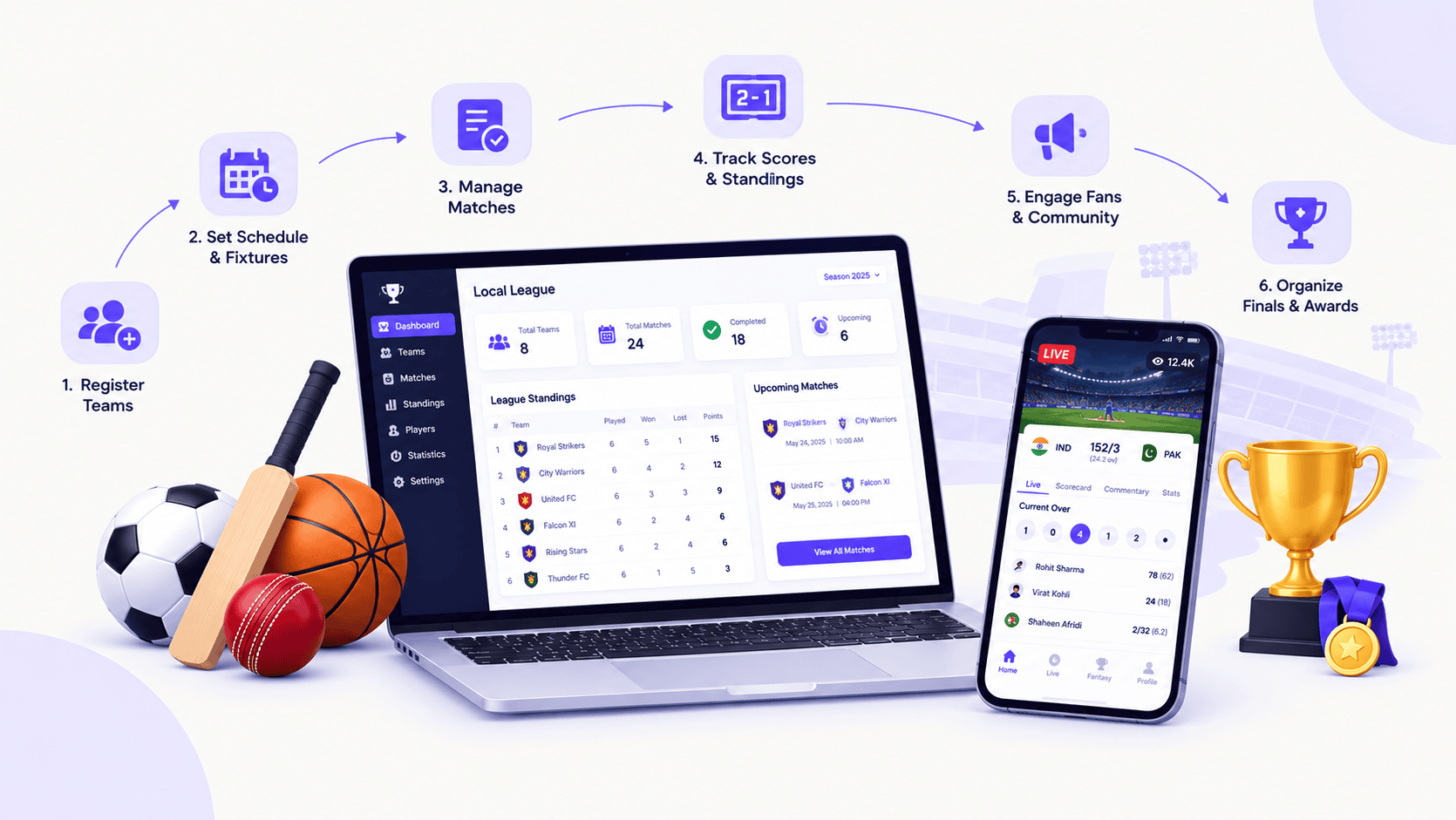
Starting a local sports league is about more than bringing teams together. It is about building a reliable community where players can compete, develop their skills, enjoy the game, and return for another season. Whether you want to organize a local football league, basketball competition, cricket tournament, volleyball league, or recreational sports program, success depends on having a clear plan, the right people, suitable facilities, and an effective management system.
The good news? You do not need a huge budget, professional facilities, or dozens of employees to get started. You need to understand your community, organize your resources, establish fair rules, and create a competition people genuinely want to join.
The real challenge begins after registration opens. You must manage teams, coordinate fixtures, track scores, resolve disputes, communicate changes, and keep everything running smoothly throughout the season. Without a structured approach, even a promising league can quickly become difficult to manage.
In this blog post, we’ll explain how to start and run a local sports league from scratch, covering everything from choosing a sport and recruiting players to managing finances, using sports management software, and growing your league over time.
What Is a Local Sports League?
A local sports league is an organized competition in which teams or individual players from a particular community, town, city, school, workplace, or recreational group compete according to established rules and a defined schedule.
Unlike a one day sporting event, a sports league usually runs for several weeks or months. Participants play multiple matches, earn points, build standings, and may qualify for playoffs or a championship at the end of the season.
Local sports leagues can serve different audiences. A youth football league might focus on skill development and teamwork, while an amateur cricket league may emphasize competitive performance. A recreational basketball league might prioritize fitness, social connections, and enjoyment.
The format depends on the community, the sport, available facilities, and the organizers’ goals.
Why Start a Local Sports League?
A well managed local sports league can create lasting value for both participants and the wider community.
Build a stronger sports community. Regular competitions bring players, coaches, families, supporters, and volunteers together around a shared interest.
Make sports more accessible. Local leagues give people opportunities to participate without traveling long distances or joining expensive professional programs.
Develop local talent. Consistent competition helps players improve their skills, understand teamwork, and gain valuable match experience.
Create opportunities for local businesses. Sponsors, sports shops, food vendors, fitness centers, and community organizations can benefit from partnerships with local leagues.
Establish a sustainable sports organization. With consistent participation, sensible budgeting, and strong management, a local league can develop into a long term community institution.
The key is to create a league that serves its participants rather than focusing exclusively on winning, collecting fees, or attracting sponsors.
How to Start and Run a Local Sports League
Step 1: Choose your sport and define your league’s purpose
Your first decision should be what kind of league you want to establish and whom it will serve.
Start by identifying the sports people in your community already enjoy. Football, basketball, cricket, volleyball, badminton, baseball, softball, and futsal can all work well, depending on local interests and available facilities.
However, popularity alone should not determine your decision. Consider the cost of equipment, facility availability, the number of players needed, the availability of officials, and how frequently participants can play.
Next, define your league’s purpose. Will it be a competitive amateur league, a recreational competition, a youth development program, a workplace league, or an inclusive community sports initiative?
Your answer will influence almost every subsequent decision, including registration fees, competition rules, staffing, scheduling, and marketing.
For example, a recreational football league may benefit from flexible registration and an emphasis on participation. A competitive basketball league may require certified officials, stricter eligibility requirements, detailed statistics, and a formal playoff structure.
Practical tip: Begin with one sport and a clearly defined audience. Expanding into multiple sports before your first league is stable can increase costs and administrative complexity unnecessarily.
Step 2: Research local demand
Before booking facilities or purchasing equipment, determine whether enough people are interested in participating.
Talk to potential players, local coaches, school administrators, community groups, sports clubs, and recreational organizations. Ask what they want from a league, when they can participate, how far they are willing to travel, and what fees they can reasonably afford.
Use local social media groups, community forums, and simple online surveys to measure interest.
You can also create a preliminary registration or waitlist form to collect expressions of interest. Ask respondents about their preferred sport, skill level, availability, and whether they already have a team.
The objective is to establish realistic demand before committing substantial resources.
For example, if 80 people express interest in an amateur volleyball league, you can estimate the potential number of teams based on your chosen roster size. You should still confirm actual registrations before making expensive commitments.
Research existing leagues, too. Identify their strengths, weaknesses, fees, schedules, and target audiences. Instead of copying another organization, look for an unmet need.
Perhaps local players want more affordable registration, better scheduling, a beginner friendly competition, or more transparent standings.
The best local sports league is not necessarily the biggest one. It is the one that meets a genuine community need and can operate consistently.
Step 3: Create a practical business and operating plan
A successful sports league needs a clear operating plan, even if it is run entirely by volunteers.
Document the league’s objectives, target audience, expected participation, competition format, season dates, venue requirements, estimated costs, registration fees, and responsibilities.
Decide whether the league will operate informally, through an existing sports club, as a nonprofit organization, or as a registered business. The appropriate structure depends on your country, funding model, ownership, and long term goals.
For a more formal organization, investigate applicable registration, tax, employment, child protection, data privacy, and financial reporting requirements.
Your operating plan should also define how decisions will be made. Identify who can approve expenses, change schedules, interpret rules, resolve disputes, and communicate official announcements.
A written plan prevents confusion when the league grows or responsibilities change hands.
Step 4: Build a realistic budget
One of the most important steps in starting a local sports league is understanding how much it will cost to operate a complete season.
Your budget should cover all essential expenses rather than only the obvious costs, such as equipment and venue rental.
Typical expenses include:
| Expense category | What to include |
|---|---|
| Facilities | Field, court, gym, or ground rental |
| Officials | Referees, umpires, scorers, and other match officials |
| Equipment | Balls, nets, cones, uniforms, and first aid supplies |
| Insurance | Applicable liability and participant coverage |
| Administration | Registration, payment processing, and management tools |
| Marketing | Promotional materials, website, and local advertising |
| Awards | Trophies, medals, and championship prizes |
| Contingency | Unexpected expenses and rescheduled matches |
Obtain actual quotations wherever possible. Facility rental and insurance costs can vary substantially by location, sport, participant age, and coverage requirements.
Next, identify your potential sources of income. These may include player registration fees, team entry fees, sponsorships, grants, donations, merchandise, and permitted event revenue.
Calculate your break even point before setting registration prices.
Break even formula:
Break even participants = Total operating costs ÷ Fee per participant
For example, suppose your estimated season budget is $3,000 and you charge $60 per player.
You need 50 paid registrations to cover the estimated costs, assuming the fee is your only source of income and there are no additional per participant costs.
In practice, include payment processing charges, possible refunds, variable expenses, and a reasonable contingency. If your league depends on a minimum number of registrations, establish that threshold before opening enrollment.
Keep league finances transparent. Record income and expenses, issue payment confirmations, reconcile transactions, and establish clear approval procedures for spending.
Step 5: Secure a suitable sports facility
Your venue influences the league’s capacity, schedule, accessibility, operating costs, and overall participant experience.
Depending on the sport, potential venues include municipal parks, school grounds, community centers, sports complexes, private gyms, and dedicated playing fields.
Before signing an agreement, confirm that the venue meets the sport’s requirements and can accommodate the anticipated number of teams.
Check availability for the entire season, including playoffs and potential makeup games. Confirm rental costs, permitted operating hours, equipment access, lighting, parking, changing rooms, accessibility, and restroom facilities.
For outdoor sports, establish what happens during rain, extreme heat, poor air quality, or unsafe playing conditions.
You should also confirm whether the venue requires proof of insurance, permits, qualified supervision, or specific safety arrangements.
Do not commit to more facility time than you can reasonably fill. A smaller, well organized league is usually easier to manage than a large competition with excessive overhead.
Step 6: Establish clear rules and competition formats
Every local sports league needs written rules before the first match.
Your rules should explain team eligibility, roster requirements, match duration, scoring, substitutions, player conduct, penalties, forfeits, postponements, protests, disciplinary actions, and playoff qualification.
Sport specific rules should reflect the relevant governing body’s rules or the format you have explicitly adopted.
You should also establish a code of conduct for players, coaches, officials, spectators, and volunteers.
Explain how misconduct will be handled, who reviews complaints, how decisions can be appealed, and what consequences may apply.
For youth leagues, include appropriate safeguarding procedures and age specific participation requirements.
Choose the right competition format
The best format depends on the number of teams, available dates, facility capacity, and desired level of competition.
Round robin: Every team plays every other team, usually once or more. This works well when you want participants to have multiple matches and standings to reflect performance across the season.
Home and away: Teams play opponents at their own venue and at the opponent’s venue, where applicable. This creates more fixtures and requires additional scheduling flexibility.
Single elimination: Teams are eliminated after one loss. This is suitable for short competitions but gives some teams very little playing time.
Double elimination: Teams generally remain in contention until they have lost twice. This offers a second chance but requires more matches and a more involved bracket.
League plus playoffs: Teams compete in a regular season before the highest ranked teams enter a playoff or championship. This is a common option for leagues that want both consistent competition and an exciting finale.
For example, an eight team league could use a single round robin, giving every team seven regular season matches. A playoff can follow if the venue calendar and budget allow.
Publish the points system, tie breakers, forfeiture rules, and playoff qualification criteria before the season begins. Never change important competitive rules midway through a season without a clearly justified and consistently applied process.
Step 7: Recruit teams, players, coaches, and officials
Once your format and operating plan are ready, start building your participant community.
Promote the league through local sports clubs, schools, universities, community organizations, social media groups, recreational centers, and personal networks.
Create a clear announcement explaining the sport, location, age or skill requirements, registration deadline, season dates, estimated costs, and how to participate.
Make it easy for people to join as either a complete team or an individual player if your format allows it.
Individual registration is particularly useful for recreational leagues because not everyone already belongs to a team. You can group these players into teams based on skill, availability, and other relevant requirements.
Recruit coaches and team captains early. They can help coordinate rosters, communicate with participants, and encourage attendance.
Recruit referees, umpires, scorekeepers, and other officials before the season starts. Qualified officials are essential to fair competition, and availability may be limited during busy sports seasons.
For youth competitions, use appropriate screening, references, safeguarding procedures, and training for coaches and volunteers where required.
Confirm participation through completed registration and payment rather than relying exclusively on verbal promises.
Step 8: Set up registration and payments
A well designed registration process reduces administrative work and helps participants understand exactly what they are signing up for.
Your registration form should collect only the information needed to operate the league safely and efficiently.
Depending on the sport and participant group, this may include the participant’s name, contact details, team affiliation, age or eligibility information, emergency contact, relevant consent forms, and payment status.
For minors, collect the appropriate parent or guardian information and consent.
Publish the registration fee, payment deadline, refund policy, cancellation terms, and what the fee covers.
If teams pay collectively, explain who is responsible for payment and what happens if a roster changes or a player withdraws.
Consider offering early registration, team discounts, or a limited number of reduced fee places if your budget permits.
Use a registration system that can maintain accurate participant records and reduce duplicate entries. For a very small league, a basic form and spreadsheet may be sufficient initially. As registrations increase, a dedicated platform can simplify payment tracking, team assignments, waivers, and reporting.
Protect personal information by restricting access to authorized personnel and following applicable privacy laws.
Step 9: Create a fair and reliable match schedule
Scheduling is one of the most demanding parts of sports league management.
You must coordinate team availability, venue access, official assignments, match duration, rest periods, holidays, and potential weather disruptions.
Start by calculating how many matches you can accommodate each week. Consider the number of available fields or courts, the length of each match, setup time, and the hours your venue is available.
Then build your fixtures around the competition format.
For example, an eight team round robin league requires 28 matches if every pair of teams meets once. If all teams can play simultaneously across four suitable playing areas, the competition could complete a round in a single time slot. With fewer facilities, it will require more time slots or match days.
These calculations should guide your registration capacity rather than forcing you to solve an impossible schedule after teams have joined.
A reliable schedule should distribute early and late matches fairly, provide reasonable rest between games, avoid unnecessary repeat matchups, and account for venue limitations.
Publish the complete schedule well before the season begins. Include dates, start times, locations, team names, and any relevant match day instructions.
Choose one official location where participants can always find the latest fixtures. When changes occur, update that source first and notify the affected teams.
A digital scheduling system becomes particularly valuable when the league has multiple divisions, venues, or weekly competitions.
Step 10: Prepare for safety, insurance, and emergencies
Player safety should be built into your league’s operating procedures from the beginning.
Identify the risks associated with your sport and venue. Establish appropriate equipment standards, facility inspection procedures, emergency contacts, first aid arrangements, and processes for reporting injuries or unsafe conditions.
Confirm what insurance coverage is appropriate for your organization. Depending on the sport and jurisdiction, you may need general liability coverage, participant accident coverage, professional liability coverage, or other protection.
Check facility requirements, governing body rules, and local regulations before purchasing a policy. Do not assume a participant waiver replaces insurance or eliminates legal responsibilities.
Create a written emergency action plan that explains how to respond to serious injuries, severe weather, fire, or other emergencies.
For youth leagues, establish clear safeguarding policies, appropriate supervision, authorized pickup procedures where relevant, and a process for reporting concerns.
Assign someone responsibility for checking that these procedures are followed during every match day.
Step 11: Organize match day operations
A sports league becomes credible when match days are consistent, fair, and well organized.
Before each match day, confirm venue access, fixture details, officials, equipment, team availability, and any special arrangements.
Assign clear responsibilities to the people working on site. One person might manage team check in, another might coordinate officials, and another might record results and handle administrative issues.
Before kickoff, verify that teams meet eligibility requirements and that the playing area is safe.
During matches, ensure officials can apply the rules independently and that scorekeepers record results accurately.
After each game, confirm the final score with the appropriate official before publishing it.
A simple match day checklist can help:
| Stage | Essential action |
|---|---|
| Before matches | Inspect facilities and confirm teams and officials |
| During matches | Monitor safety, timing, conduct, and scoring |
| After matches | Verify scores and record incidents |
| End of match day | Update standings and communicate changes |
Prepare backup arrangements for absent officials, missing equipment, and venue problems. A clear contingency plan prevents small disruptions from becoming major operational issues.
Step 12: Track scores, standings, and player statistics
Accurate results make a league more transparent and engaging.
At a minimum, publish completed match results, upcoming fixtures, team standings, and the criteria used to rank teams.
Depending on the sport, you may also track goals, assists, points, wickets, runs, player appearances, clean sheets, or other relevant statistics.
Keep an auditable record of results and provide a straightforward process for reporting errors.
For example, a football league might award three points for a win, one for a draw, and none for a loss. The standings could then rank teams by total points, followed by the published tie breakers.
Use consistent rules for recording forfeits, postponed games, disciplinary penalties, and incomplete matches.
Avoid publishing sensitive personal information or unnecessary individual data, particularly in youth competitions.
Live score updates and accessible standings can also improve the spectator experience. Players, coaches, families, and supporters can follow the competition without contacting the organizer for every result.
Step 13: Communicate clearly with teams and participants
Poor communication can undermine even a well planned sports league.
Participants need to know when they are playing, where they should arrive, what equipment they need, and how to respond to schedule changes.
Choose an official communication channel for league announcements. This could be a website, league management platform, email list, or another channel that participants regularly check.
Send registration confirmations, fixture announcements, payment reminders, rule updates, and cancellation notices in a timely manner.
Keep routine announcements separate from urgent alerts. For example, a weather cancellation should be clearly identified and sent directly to affected teams rather than buried in a long conversation.
Establish reasonable response times for questions and identify who can address different issues.
Team captains can help distribute information, but the league should remain responsible for maintaining an authoritative schedule and official rules.
A useful principle is simple: every participant should know where to find the latest information without having to search through multiple conversations.
Step 14: Use sports management software to simplify operations
Managing a local sports league often begins with spreadsheets, messaging apps, and online forms. These tools can work for a small competition, but they become harder to coordinate as the number of teams, matches, and participants increases.
Sports management software helps bring important league activities into a more organized workflow.
Depending on the platform, it may support online registration, team management, fixture generation, match scoring, standings, tournament brackets, player statistics, notifications, and reporting.
Instead of maintaining separate records for registrations, schedules, and results, organizers can use a centralized system to keep information consistent.
Consider a league with 16 teams playing across two divisions. The organizer must manage team rosters, weekly fixtures, officials, match results, standings, and schedule changes. Updating everything manually can consume considerable time and increase the risk of mistakes.
A suitable management platform can reduce repetitive administrative tasks and make information easier to access.
What features should you look for?
Choose software based on the actual needs of your league rather than the number of features advertised.
Registration and payment management are important when participants need to enroll and pay online. Scheduling tools are useful when many teams share a limited number of facilities. Live scoring and standings help participants follow the competition, while communication tools make it easier to distribute announcements.
For larger leagues, role based permissions, reporting, multiple divisions, and historical records may also be valuable.
Before choosing a platform, consider its pricing, ease of use, mobile experience, data protection, support, and ability to handle your competition format.
A small community league may need only basic scheduling and results management. A growing multi division league may benefit from a more comprehensive solution.
The goal is not to introduce technology for its own sake. It is to make the league easier to operate and the participant experience more reliable.
Step 15: Market your league and attract sponsors
A successful launch requires more than a registration form. You need to communicate the value of your league and reach the people most likely to participate.
Create a simple website or landing page that explains the competition, eligibility requirements, schedule, registration process, fees, and contact information.
Use local search optimization to help people discover the league. Include relevant information about the sport, city or service area, competition level, and registration availability.
For example, a local organization might create pages targeting searches such as “amateur football league in [city]” or “local basketball league registration.”
Publish useful content, including team announcements, upcoming fixtures, match reports, player achievements, and final standings. With appropriate permissions, photos and short videos can make your league more engaging.
Use local social media groups, community newsletters, schools, sports clubs, and partner organizations to expand your reach.
How to find local sports sponsors
Begin with businesses that share an audience with your participants. Potential sponsors include sports shops, fitness centers, restaurants, physiotherapy clinics, local retailers, and other community focused organizations.
Prepare a short sponsorship proposal that explains your audience, expected season duration, promotional opportunities, and what the sponsor receives in return.
Possible benefits include logo placement, website mentions, event banners, social media recognition, or naming rights for a division or championship.
Be realistic about the value you can deliver. Do not promise attendance figures, audience reach, or media exposure that you cannot substantiate.
Sponsorship should support the league without compromising participant safety, fairness, or the organization’s core purpose.
Step 16: Keep players engaged throughout the season
Registration numbers matter, but long term success depends on whether participants want to return.
Players are more likely to remain involved when matches are organized, rules are applied consistently, communication is reliable, and the overall experience feels worthwhile.
Publish results promptly, recognize team and individual achievements, celebrate milestones, and maintain a respectful environment.
Make sure competitive opportunities remain appropriate for different skill levels. If your league attracts both beginners and experienced players, separate divisions may improve the experience for everyone when resources permit.
Collect feedback during the season rather than waiting until problems become serious.
Ask participants about scheduling, officiating, venue quality, communication, fees, and overall satisfaction. Review recurring complaints objectively and explain what changes you plan to make.
For recreational leagues, social events and community activities can strengthen connections beyond the competition itself.
For youth leagues, development, enjoyment, inclusion, and safe participation should remain central goals.
Step 17: Review performance and plan the next season
Your first season is an opportunity to learn how your operating model performs in practice.
After the final match, review financial performance, registration numbers, attendance, cancellations, complaints, sponsor feedback, and participant retention.
Compare actual expenses with your original budget. Identify where costs were higher than expected and where your processes created unnecessary work.
Evaluate whether the schedule was manageable, whether the rules were clear, and whether officials and volunteers had sufficient support.
Useful performance indicators include registration completion rate, average attendance, match cancellation rate, operating cost per participant, participant satisfaction, and the percentage of players who return for another season.
Use these findings to make specific improvements rather than expanding immediately.
If your league filled every available place and maintained reliable operations, consider adding a division or extending the season. If scheduling was difficult, improve venue planning before recruiting more teams.
Open interest registration for the next season while the community is still engaged. Share the season’s highlights, announce improvements, and give returning players clear information about upcoming registration.
A league becomes sustainable when each season creates a stronger foundation for the next.
A Practical Timeline for Launching Your Local Sports League
The time required depends on the sport, the size of the competition, and local facility and compliance requirements. For many small leagues, planning several months ahead provides room to recruit participants and resolve operational issues before opening day.
Here is an example of a 12 week launch plan.
| Period | Main priorities |
|---|---|
| Weeks 1–2 | Define the league, research demand, and select the format |
| Weeks 3–4 | Build the budget, investigate legal requirements, and secure facilities |
| Weeks 5–6 | Recruit officials and volunteers, finalize rules, and prepare registration |
| Weeks 7–9 | Promote the league, confirm teams, and collect registrations |
| Weeks 10–11 | Finalize rosters, fixtures, payments, and match day procedures |
| Week 12 | Confirm readiness, communicate final details, and launch the season |
This is a planning example rather than a universal deadline. A youth league, a large multi division competition, or a league requiring complex facility agreements may need more time. Keep flexibility in your plan for delays and incomplete registrations.
Conclusion: Build a Local Sports League That Lasts
Starting a local sports league is an opportunity to create something that extends beyond the playing field. It can bring neighbors together, develop local talent, encourage healthier lifestyles, support community businesses, and create sporting traditions that continue for years.
The foundation is straightforward: understand your audience, plan your budget, secure suitable facilities, establish fair rules, recruit reliable people, and make registration and communication easy. Then manage every match consistently, prioritize safety, track results accurately, and use participant feedback to improve each season.
As your league grows, invest in systems that make administration easier rather than allowing complexity to slow you down. The right processes and sports management tools can help you spend less time coordinating spreadsheets and chasing updates and more time improving the competition.
Start small, organize well, and build trust with every match. That is how a local sports league develops from a simple community idea into a sustainable sporting organization.
Frequently Asked Questions About Starting and Running a Local Sports League
How do you start a local sports league?
To start a local sports league, choose a sport and target audience, research community demand, create an operating plan, estimate costs, secure facilities, establish rules, recruit teams and officials, and open registration. Before the first match, finalize the schedule, safety arrangements, and communication procedures.
How many teams do you need to start a sports league?
The minimum number depends on the sport and competition format. Four teams can support a small round robin competition with playoffs, while six to eight teams can offer more variety in many recreational leagues. Confirm that your available facilities, budget, and season length can support the number of teams you recruit.
How much does it cost to start a local sports league?
The cost varies by sport, location, facility rental, insurance requirements, equipment, officials, and season length. Prepare a budget covering both fixed and variable expenses, estimate realistic registration income, and include a contingency before committing to major expenses.
How do local sports leagues make money?
Local sports leagues can generate income through player registration fees, team entry fees, sponsorships, grants, donations, merchandise, and permitted event revenue. The best funding model depends on whether the league is recreational, nonprofit, community based, or commercially operated.
Do you need insurance to run a local sports league?
Insurance requirements depend on the jurisdiction, sport, facility, and organizational structure. Many leagues and venues require appropriate liability coverage, and additional coverage may be advisable. Confirm the applicable requirements with the venue, governing body, and a qualified insurance professional before starting.
What is the best format for a local sports league?
A round robin format works well when every team should play multiple opponents. A knockout format is useful for short competitions, while a regular season followed by playoffs combines sustained competition with a championship finish. Choose the format that fits your team count, available dates, and budget.
How do you schedule matches for a local sports league?
Start with the number of teams, competition format, venue availability, match duration, and officials. Calculate the number of fixtures, allocate suitable time slots, account for rest periods and blackout dates, and reserve flexibility for postponed games. Publish the complete schedule early and communicate changes through an official channel.
What software is best for managing a local sports league?
The best sports league management software depends on the league’s size and requirements. Look for suitable registration, team management, scheduling, scoring, standings, communication, and reporting features. Smaller leagues may begin with basic digital tools, while larger competitions can benefit from a centralized management platform.
How do you attract more players to a local sports league?
Promote the league through community groups, local sports clubs, schools, social media, and a search optimized website. Make registration straightforward, publish clear information about fees and schedules, offer suitable participation options, and encourage referrals from existing players.
How can you retain players from one season to the next?
Deliver reliable scheduling, fair officiating, transparent rules, prompt results, responsive communication, and a positive playing environment. Collect feedback, address recurring problems, and communicate improvements before the next registration period.
Can you run a sports league without dedicated management software?
Yes. A small league can often operate using spreadsheets, online forms, and communication tools. However, as the number of teams, matches, and administrative tasks increases, a centralized sports management system can reduce repetitive work and help keep information accurate.